

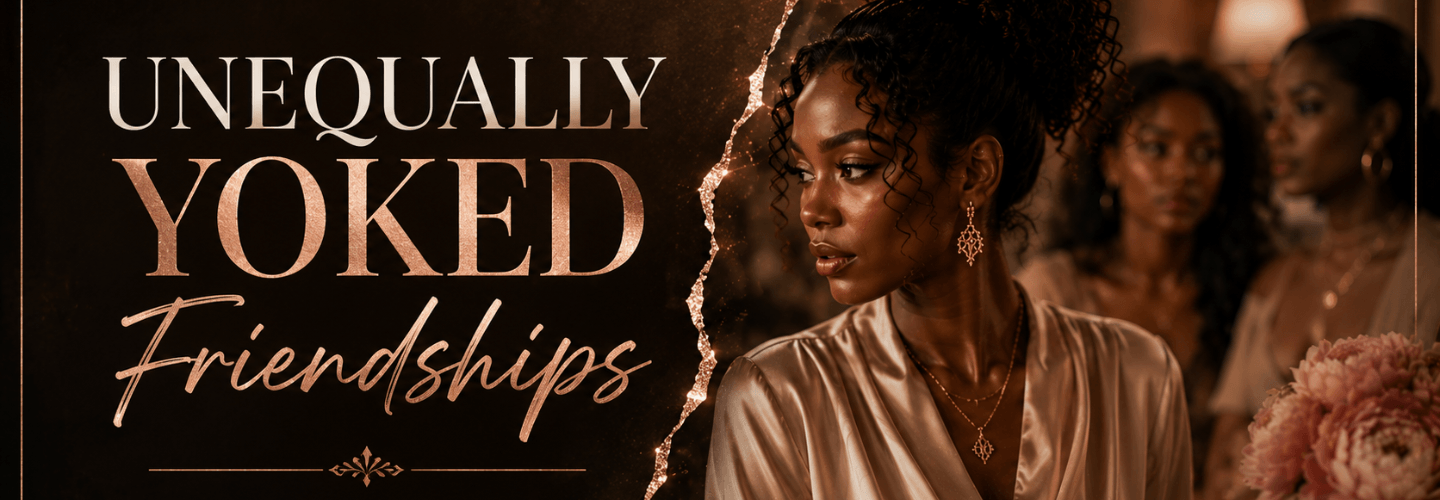
There’s a phrase most people only apply to marriage.
Unequally yoked.
But some of the most quietly damaging seasons of my life didn’t happen inside a romantic relationship.
They happened inside friendships I had no language for.
Because friendship feels safe to keep. You’re not building a life with her. You’re not dating her. She’s just your friend.
That’s what we tell ourselves when something starts feeling off — and that phrase is exactly what keeps us sitting in something we’ve already outgrown.
But here’s what I’ve learned through years of inner healing work: the people closest to you don’t just witness your life. They shape it. Your thinking, your confidence, what you believe you deserve, what you’re willing to tolerate — all of it is being quietly influenced by whoever has your proximity.
So when two people are no longer operating from the same level of awareness, the friendship doesn’t just feel different.
It starts costing you something.
1. Friendship Insecurity Begins When One Person Starts Growing
Everything feels fine initially
The tension begins when one person starts growing.
Maybe you started healing. Maybe you became more confident. Maybe you launched something, built something, finally started choosing yourself in ways you never had before.
And suddenly the friendship that once felt easy starts feeling strange.
Not because anything happened.
Because you changed — and she didn’t.
This is where insecurity enters, quietly. Not because she’s a bad person. But comparison is always easier than growth. Something just feels off.
Toxic friendship patterns are rarely overt.
They accumulate.
Before You Can Name It, You Have to See It
This is the part most women skip — and it’s the part I had to work through myself before I could write about it clearly.
A lot of us arrive at this moment carrying years of confusion about why a friendship that once felt safe started feeling like a drain. We’ve been told we’re “too sensitive.” That we’re “reading into things.” That she means well.
And sometimes that’s true.
But sometimes it isn’t.
The Masterpiece Within was written for exactly this — for the woman doing the work of examining her relationships, her patterns, and her inner world with honesty. Not to create villains. But to develop the kind of spiritual discernment that helps you tell the difference between a friendship going through a season and a friendship that has quietly been working against your becoming.
If you’re in the middle of untangling this right now, that book was written for you. It gives language to what you’ve been feeling but couldn’t name.
Explore The Masterpiece Within →
2. When Comparison Turns Into Envy in a Friendship
Comparison rarely stays comparison.
It evolves.
When someone is repeatedly measuring their life against yours, something underneath begins to shift. The very things she once celebrated about you become the things she can’t stop looking at.
Your peace.
Your spiritual growth.
Your opportunities.
The way you’ve started moving through the world.
And here’s what makes envy inside a toxic female friendship so hard to name: it rarely looks hostile.
It looks like silence.
It looks like subtle dismissiveness
It looks like a lack of enthusiasm when good things happen for you.
It looks like being the last to respond, the first to leave, the one who hears your good news with the energy most people reserve for bad weather.
The celebration becomes smaller. The support becomes inconsistent. And eventually you start realizing:
She’s not unhappy.
She’s just unhappy for you.
3. How Triangulation Happens in Toxic Female Friendships
This one almost never gets discussed, and it sits at the intersection of emotional manipulation and friendship in a way that catches most women completely off guard.
When someone lacks confidence in their own discernment, they become easy to influence.
Someone else enters the picture — a mutual acquaintance, a jealous coworker, a family member with an agenda — and suddenly your friend is repeating things that aren’t true. Believing stories she never verified. Questioning your intentions without ever coming to you directly.
This is recognizing manipulation tactics in their subtlest form: not directed at your friend, but moving through her.
People who haven’t done the inner work of developing independent thinking naturally borrow other people’s perceptions. It’s easier than doing the inner work of deciding what they actually believe.
But it’s dangerous for you — because your friendship is now being steered by voices that were never in it.
4. Emotionally Unavailable Friends Can’t Support You in a Crisis
Friendship isn’t supposed to be perfectly balanced all the time.
Life happens. Sometimes one person holds more. That’s normal, and that’s love.
But there’s a difference between seasons of imbalance and a relationship that is structurally one-sided.
One person is always stabilizing, always encouraging, always the one doing the emotional labor of holding things together.
And you don’t notice it fully until you need support.
Until something falls apart for you — and you reach toward the person you’ve been carrying for years — only to find there’s nothing there to hold on to.
Not because she doesn’t care.
Because she was never standing beside you.
She was leaning on you.
Those are not the same thing.
This is one of the patterns that most needs inner healing work — not to place blame, but to grieve what the friendship actually was versus what you believed it to be.
5. Destiny Swapping: When Her Focus Shifts From Her Life to Yours
This is the deepest layer — the one I call destiny swapping.
When someone becomes more invested in your path than their own, something starts to shift in the dynamic that is genuinely difficult to articulate.
But women who’ve experienced it recognize it immediately.
She’s tracking your decisions.
Studying your moves.
Replicating your language, your aesthetic, your positioning.
Not necessarily consciously — but it’s happening.
What should have been inspiration becomes imitation.
What should have been admiration becomes a quiet, consuming focus.
And what should have been her becoming — her own unfolding, her own vision — gets abandoned altogether.
Because it’s easier to follow someone else’s path than to sit with the discomfort of building your own.
But what makes this dynamic so dangerous is that it rarely moves in only one direction.
While she’s becoming increasingly focused on your life, you’re being exposed to hers.
Her habits.
Her fears.
Her distractions.
Her limitations.
Sometimes those things get introduced intentionally. Sometimes they don’t. But proximity has a way of transferring more than influence.
Over time, you may find yourself adopting patterns that were never yours to carry. Spending time on things that don’t matter. Entertaining beliefs that don’t belong to you. Drifting away from the very things you once felt called to pursue.
This is what I consider a natural destiny swap.
Not necessarily something mystical.
Not necessarily something malicious — even though it could very well be.
Just two lives pulling on each other in opposite directions.
One person becomes increasingly attached to a future that was never theirs.
The other slowly moves further away from the future that was.
And before either person realizes what’s happened, what should have been her path gets abandoned while what should have been yours becomes delayed, diluted, or derailed.
How to Know If a Friendship Has Become Unequally Yoked
Not every friendship is meant to last forever.
Not every person who was right for who you were is right for who you’re becoming.
That doesn’t make either of you wrong.
But it requires spiritual discernment — the kind that only comes from doing your own inner healing work and learning to trust what you observe, not just what you’re told to believe.
Choose women who are genuinely building their own lives.
Choose women who can think independently.
Choose women whose support doesn’t shrink when your life expands.
Choose women who don’t need you to stay small in order to feel secure.
Because proximity is powerful in ways we consistently underestimate.
The people in your inner circle shape how you think long before they influence what you do.
And recognizing toxic friendship patterns early — before they become years of misplaced loyalty — is one of the most important things you can do in service of your own growth.
The wrong friendship won’t just cost you peace.
Sometimes it costs you purpose.
And you didn’t come this far to let proximity be the thing that pulls you back.
Healing After Toxic Friendships and Emotional Manipulation
If you’ve experienced:
- toxic female friendships
- emotional manipulation
- friendship betrayal
- envy in friendships
- people pleasing
- self-abandonment
- unhealthy relationship patterns
then you’re already doing the deeper work of understanding what happened and why.
The Masterpiece Within was written for the woman finally ready to examine her inner world with honesty — and remember who she was before she started adapting.
Inside, you’ll learn how to rebuild self-trust, strengthen boundaries, stop abandoning yourself for approval, and develop the discernment needed to recognize unhealthy relationship dynamics before they become years of misplaced loyalty.
Because healing isn’t about becoming someone new.
It’s about returning to the woman you were before you learned to make yourself smaller.
Related reading:
Spiritual Discernment in Relationships
The Toxic Sisterhood: When Women Become the Threat
Hidden Signs of Betrayal in Female Friendships
